Tee It Up!

tee3According to an industry poll, 44% of US consumers own a promotional t-shirt.  Surprised?  Probably not!  Considering how many tees most of us have stashed in our drawers at home, this statistic is probably not breaking news.  There are more fabric color choices than ever, with creative decoration options like sublimation, bleaching, all over screenprints, and metallic inks that allow for unique logo treatments for all types of brands.

But who should corporate marketers target with this ever-popular wardrobe staple?  Read on for the numbers that tell the story.

What age group is most likely to own a branded shirt?

  • 48%:  21 to 34 years old
  • 45%:  35 to 44 years old
  • 33%:  45 to 54 years old
  • 35%:  55+

Do Women or Men own the most promo shirts?

  • Men:  45%  Women:  40%

Of the twelve U.S. metro cities where people were polled, where are the residents most likely to own a promotional t-shirt?

  • Atlanta, Georgia:  46% vs 44% in the U.S.

Of the 21 international metro areas, where do consumers own the most branded shirts?

  • Rome, Italy:  53%

What racial demographic owns the most promotional t-shirts?

  • Latinos:  52%

Which voters are most likely to own a branded shirt?

  • Independent:  46%
  • Republicans:  41%
  • Democrats:  40%

T-shirts are an inexpensive giveaway that can carry a brand message in unlimited creative ways.  Young male consumers, in particular, are likely to continue wearing the shirt, but their appeal is broad and the high number of impressions captured from repeated exposure on the street, in the gym and around town makes it an easy choice for the investment.  Don’t overlook this seemingly common promotional giveaway for the next marketing event – the numbers will support your choice!

(Image via megbiram.com)

In 2014, Resolve To Shake Things Up

shakersNew Year’s resolutions range from ambitious (lose 30 pounds in 30 days); to vague (be a better person); to practical (reduce Starbucks trips from every day to twice a week).  In business, as in our personal lives, positive change is always the goal when making these resolutions.   And when you resolve to shake things up by abandoning complacency and embracing an entirely new approach to building your brand, that change can be surprisingly rewarding.

“Shaking things up” will mean something different for every firm.  Most companies know how they want their brand to be perceived,  but only a few can afford to pay for high profile advertising campaigns to bring that message to the consumer.  Apple always comes to mind when we think of creative branding efforts, and who can forget the E-Trade baby or the Budweiser frog?  However, considering that not every company enjoys that type of marketing budget, there are other ways to build your brand through interesting and unexpected methods of engagement.

Consider the following:

  • Host an event:  use music, videos and lots of social interaction to introduce your next product or service
  • Poll your customers:  with inexpensive on-line tools like SurveyMonkey there is no reason not to get the pulse of your audience through brief, focused surveys
  • Engage in social media:  Facebook and Twitter are a great place to start, but consider branching out into Instagram, Google+ and Twitter’s Vine for micro-videos
  • Extreme brand makeover:  bring your team together to consider what marketing touch points could use a makeover (printed materials, bags, pens, auto graphics, employee uniforms, etc)
  • Cause-branding:  partner with a non-profit or cause-based institution to raise social awareness while increasing corporate profits

This year’s resolution should be to consider new and exciting ways to build your brand.  Ask your internal associates, customers and vendor partners to offer ideas – you may be surprised how fun it can be to shake things up!

It Is All About The Presentation

gift wrapCorporate gift giving is serious business.  It helps establish or enhance important relationships with customers and employees.  Different than an incentive award given to high achievers, or promotional products used as advertising, the corporate gift should affirm the personal relationship between the giver and the recipient.  And there’s no better way to achieve that sense of partnership than with heart felt attention to the details around the presentation of the gift.

Investing in nice wrapping paper, unique embellishments and quality card stock with a hand written note makes a statement about the value of not only the gift itself, but of the thought behind it.  Keeping in mind that creative ideas for gift wrapping don’t have to include elaborate bows or Martha Stewart crafting talents, I have listed below a few simple ways to upgrade your next gift presentation.

  • Wrap the gift box in single color wrapping paper that matches your corporate color with wide logo ribbon tied in a simple bow
  • Use brightly colored handle bags for small gifts, stuffed with logo tissue paper, and labeled with the recipient’s name
  • Add plain colored tissue or crinkle paper inside a box or bag that comes in a coordinating color; seal with a simple single color logo label
  • For baskets, bags or odd-shaped boxes, use translucent gift wrap secured with an extra long metallic twist tie that holds a large colorful hang tag
  • Put locally sourced food items inside a customized gift tin or colorful gabled box custom printed with the company logo or seasonal message

Of course, most corporate associates are working hard on the tasks associated with their daily jobs and have little time left over for wrapping gifts.  Understandable, but not a reason to avoid this important part of the gift giving process.  Gift wrapping is often offered for a small fee, or included in the added value services of your promotional products provider.   The next time you work with her or him on a corporate gift idea, make a point to ask about their service options for improving the presentation.

(Image via olderandwiser.com)

Is Your Content Marketing Strategy Working?

social-media-management1A new survey from Unisphere Research states that “Seven out of ten executives report they are employing social media to distribute content … with Facebook and Twitter being the leading platforms for customer engagement and content marketing”.  This information may not be surprising news to most marketing executives, but the reality is  “only 25% actually measure the results of the individual pieces of content they produce and distribute.”

If a company is going to allocate time and resources to content marketing strategies, there must be an equal focus on gathering and measuring the return on that investment.  It’s not enough to capture information on customer engagement driven through the various social media channels when the ultimate reason for reaching out to those customers is increasing brand awareness, reducing costs and growing sales.

In the book Managing Content Marketing by Robert Rose and Joe Pulizzi measuring the impact of your content marketing strategy is determined and outlined by creating a “Content Marketing Pyramid”, which includes the following three sections.

  • Primary content indicators: Primary indicators are the types of measurements that you want to capture (e.g., sales, costs savings, retention rates).
  • Secondary content indicators: Secondary indicators are the types of measurements that help make the case for primary indicators (e.g., lead quality, lead quantity, shorter sales cycles).
  • User indicators: These are the types of measurements that the content “doers” need to look at to help drive the secondary indicators (e.g., web traffic, “likes,” page views, search rankings).

The authors go on to explain how to segment the pyramid, with user indicators at the base (for the analytics team), the secondary content indicators in the middle (for managers reporting) and the primary content indicators at the top (for C-suite reporting).   The specific metrics depend on the organization’s individual objectives, but everyone has the same goal – improve the process.

Spending the time to pull together this information and putting that data into a format that everyone can relate to will help the organization to understand how well their content marketing strategy is working and where adjustments need to be made.   Developing a game plan to measure the impact of that strategy should be at the top of your New Year’s resolution list!

Cold Weather Staple: Fashion Fleece

fashion fleeceWhen it’s important for your brand to be seen in more places than just the customer’s backyard, fleece garments with fashionable styling, lighter weight fabrics and better fit are an option that has grown in popularity.  And since branded apparel purchases are generally more costly than the average promotional product, selecting a style that many consumers would choose for themselves is the best way to get the biggest return on those limited marketing funds.

The trends in retail fashion influence the corporate clothing market, and now that market offers styles that range from rustic, casual fleece jackets to polished, sleek options with contrasting drawcords and white metallic zippers. Performance fabrics provide warmth with less weight, and moisture-wicking technology draws perspiration away from the body in order to maintain warmth and dry skin.  Color choices range from earth tones to jewel tones, while always maintaining the classic white, black and navy for the more conservative crowd.  Even with classic college-style crewneck and hoodie sweatshirts, corporate apparel suppliers have answered the call with distressed fabrics, hockey style laced fronts and retro styling.

Gone are the days when the choices for branded sweatshirts and fleece jackets were limited to four basic (or some might say “boring”) styles offered in three colors and the five standard men’s sizes.  Enlist creative thinking and consider your audience when choosing the best fashion fleece for that next executive premium or customer gift-with-purchase – the improved brand awareness and customer appreciation will be worth it!

(Image via Tri-Mountain)

Domestic Manufacturing Makes Sense Again

american madeAccording to a survey by Boston Consulting Group in September, 2013, “More than half of the US-based manufacturing executives at companies with sales greater than $1 billion are planning to bring back production to the US from China …”.  From the viewpoint of these executives, this decision makes good financial sense.

There are 3 main considerations that are driving this movement:

  1. Labor costs:   cited by 43 percent of respondents
  2. Proximity to customers:  cited by 35 percent of respondents
  3. Product quality:  cited by 34 percent of respondents

Other factors include access to skilled labor, transportation costs, supply-chain lead time and ease of doing business.  Especially when considering products that will be sold in the US, when the cost of all of these elements are added together, manufacturing in the US begins to look more appealing as compared to the increasingly costly and complicated nature of importing from China and other off-shore countries.

In addition, while the economics of onshoring makes economic sense for the manufacturer, the social impact of adding factory and related service jobs to the US market must be appreciated as a renaissance for the American workers and consumers alike.  This revival will spark new employee training and re-training of current company associates; facilities improvements; enhanced customer service levels; faster production turn-around; and higher product quality.

Now that domestic manufacturing makes sense again, it will be easier than ever to find affordable USA-made products that can carry your corporate logo.  Consider the possibilities when discussing the next marketing project with your branded merchandise specialist!

Get Charged Up!

iBar_ChartsMobile phones, tablets, MP3 players – in our personal and business lives, much of our time is spent on-the-go, connecting with others through our battery charged devices.  They give us the ability to work from the car, listen to music while mowing the lawn and talk to family members on the way to catching the next flight.  So when considering end-of-year corporate gifts, a perfect gender-neutral option that everyone can use would be a portable battery pack for all those devices that keep  us linked to rest of our world.

Mobile chargers come in a variety of shapes, colors and sizes.  Some offer LED lights, others come equipped with dual USB ports – but all are built to offer convenience, practical effectiveness and size-appropriate dimensions to accommodate the pocket on a tight pair of a college students jeans or the jacket of the CEO’s business suit.   These devices are designed to appeal not just to the tech-savvy consumer, but more to the mainstream users of all sorts of mobile tools.

Considering their universal appeal, it makes sense that any customer would be pleased to receive a branded mobile charger, but what does the corporate giver get in return?

  • Logo Visibility:  the imprint area is usually generous, which gives the corporate logo a high profile
  • Brand Identity:  every time the user plugs in, the corporate brand will be reinforced
  • Positive Brand Association:  giving gifts that reflect the current trends shows corporate awareness of customer habits and lifestyle
  • Customer Loyalty:  customers support the brands that offer products and services that appeal to their emotions as well as servicing their needs
  • Increased Sales:  positive brand identity + expanding customer loyalty = increased sales

This holiday season, consider giving a gift that will get your customers charged up!

(Image via Idol Memory)

Two Simple Words

Thank you!“Feeling gratitude and not expressing it is like wrapping a present and not giving it.”  William Ward 

It’s client gift season, and every year companies contemplate the most appropriate way to express their gratitude to the customers and employees that make it possible for them to exist.  Questions around changing corporate policies regarding the value of gifts that are given to customers make it increasingly difficult to know how to express thanks without breaking the rules.  Tight budgets restrict the amount allocated to employee appreciation gifts, and giving something small may be perceived as an insult to that hard-working associate who stayed late every night last week to finish an important project on time.   How does an organization acknowledge the value of customers and employees?  And does it matter?

First:  YES! it matters.  We only have to look inside ourselves to realize that everyone likes to know they are appreciated.

Second:  Start informally, with two small words – Thank You!

Saying thank you to employees seems like the simplest thing we can do to improve morale, inspire change and build mutual commitment.  But in reality, those are the people that are often taken for granted, and as a result, contribute to the turmoil that ensues with high turnover.  Spontaneous, sincere and personal recognition for a job well done will often build and maintain employee loyalty, even when budgets don’t allow for end of year bonuses or expensive holiday gifts.

For customers, especially large corporate buyers that deal with long preferred vendor lists, the purchasing process is a finely tuned mechanism that relies on a calculated price submittal that deliberately omits most of the personal interaction.  Or so we are to believe.  But behind every RFQ, there is a human being that worked hard to put together a process that would deliver the fairest price for the best product.  That person, or persons, deserves our thanks for including us in the process, or, even better, giving us the order.

Finally, as a vendor, thank you is very often the last thing we expect to hear from our customers.  After all, the customer is the buyer – suppliers know enough to understand thanks are in order, but rarely expect the same in return.  On the other hand, that relationship is best served on both sides as a true partnership.  A good supplier with industry experience, product knowledge and strong customer service skills can provide solutions to problems and make life easier for the client.  A simple thank you is an easy way to say you appreciate the effort it takes to be a consistently reliable provider.

Gift season is here.  There are lots of choices for appreciation gifts – from the elite and unique, to the simple and practical.  But before considering those options, begin with two simple words – Thank You!

Keep The Sizzle, Just Deliver The Steak On Time

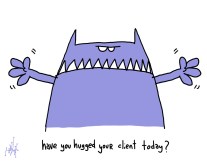
hugCustomer loyalty has much more to do with delivering on the everyday service promises than with the dazzling one-off experiences a corporate marketing team may execute twice a year.  That is not to say those extra efforts go unnoticed or unappreciated, but if the customer service team keeps the client on hold for 10 minutes, or the airlines are chronically late while losing your luggage, all the fancy reward programs won’t salvage the relationship.

Everyday services are the reason we have customers to begin with.  They expect to pay for those services, and in return, receive the prompt attention and quality of service that has been advertised.  The customer shouldn’t have to email or call three times for a price quote that the supplier claims can happen the same day.  Competitive pricing doesn’t mean the same product or service will be found tomorrow for 50% less.  And on-time delivery doesn’t mean the order arrives a day later than promised.

To increase customer loyalty, there are a few basic things to remember:

  • Build correct expectations.  Everyone’s expectations are different, even for the same service.  Approach each client as a unique individual.
  • Over-deliver:  Attention to detail; consistent, accurate follow-up throughout the entire purchase cycle; and proactive attention to customer needs before they are ready to purchase are all ways to surprise and delight without the fireworks.
  • Correct problems quickly.  Excellent service doesn’t always mean flawless service.  When problems arise, move quickly to minimize the impact on the customer.
  • Reduce their effort.  The work they must do to get their problem solved should be nominal.  Whether the problem is the initial purchase, or the unexpected product flaw after delivery, every customer should feel like they are your only priority until the problem is solved.
  • Stay consistent.   Your level of service should be the same when business is slow as it is when the phones are ringing off the hook.  Your staffing challenges should never become your customer’s problem.

Bottom line, our customers shouldn’t be expected to work or worry about the everyday services they come to us for in the first place.  Deliver what you promise, and your company will reap the rewards of improved customer retention – loyalty, repeat business and positive promotion.

(Image via  Hugh MacLeod at Gapingvoid.com)